
A horse sees a world you would barely recognize. Its eyes sit on the sides of its head and sweep nearly 340 degrees, watching the ground behind its own tail without turning around. What it sees comes in blues and yellows, with reds washed out to grey. It trades color and depth for motion.
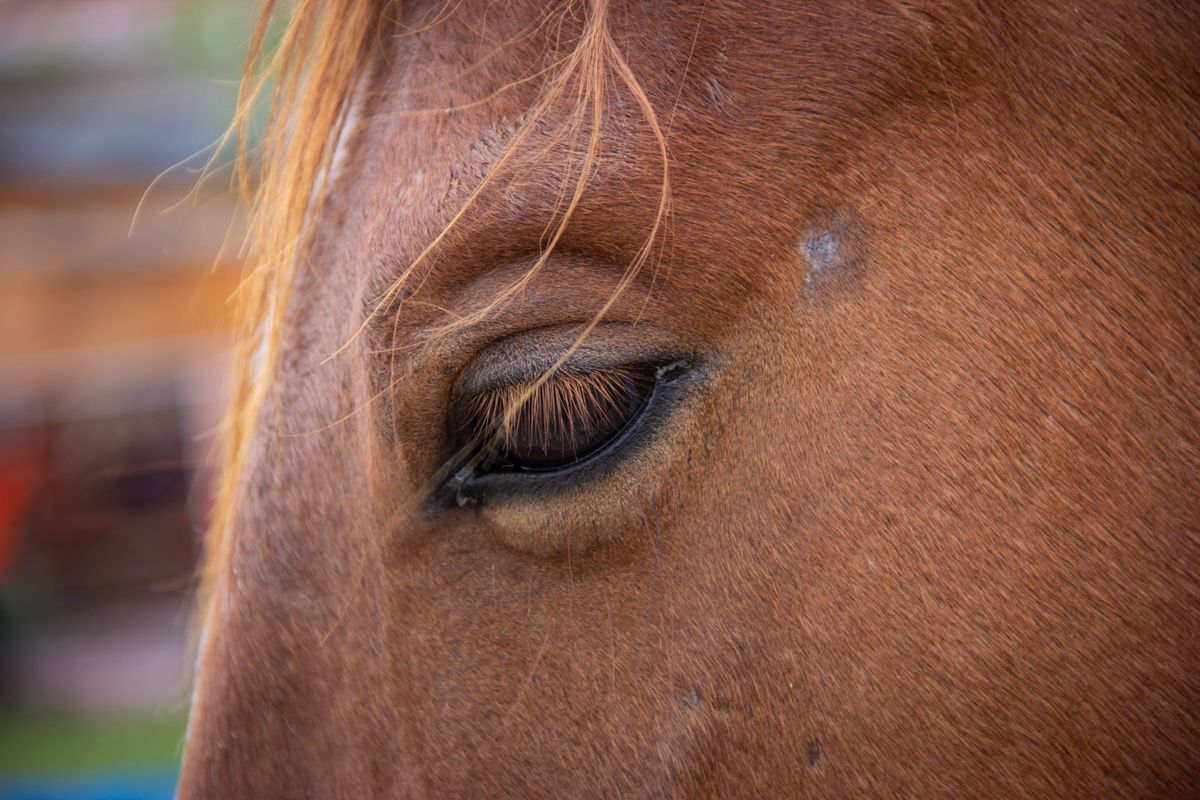
The eyes sit on the sides for a reason
Each eye covers close to 195 degrees on its own. The two fields overlap in a narrow band of about 60 to 65 degrees straight ahead, the only place a horse judges depth the way you do. Everywhere else, one eye works alone, and the horse reads movement, not distance.
That is why a horse can spot you crossing the far side of the pasture and still shy at a jacket on a fence post. Outside that band, the horse knows something moved but not how far away it is. A horse that spooks at things that aren't there is usually reacting to motion its eyes caught before its brain could place it. On uneven ground, that gap is one reason horses trip.
Two blind spots sit where you least expect them
A horse cannot see directly behind its own rump, or the patch of ground right under its nose when its head is up. Walk up silently from behind and you appear out of nowhere. Stand under the nose to clip a bridle path and your hands work in a spot the horse can only feel.
The nose blind spot also explains the head toss at a gate latch: the horse lowers its head to bring the object into view. Speak before you touch, and approach from the side where one eye can track you.
Red looks grey, and that changes the jumps
Horses carry two types of color cone to your three. They see blues and yellows well and cannot separate red from green, so red poles on green grass blur into one washed-out field. Research on jumping horses found fences that stand out from their background get read earlier and jumped cleaner.
Paint schooling fences in blue or yellow against a dark background, and a horse reads the fence from further out. A red fence on a summer field asks the horse to jump a shape it can barely pick out. In the last stride before a fence, the horse cannot see the fence at all: it drops into the blind spot under the nose, and the horse jumps on memory and trust. A schooling ring can do the same for the price of a tin of paint.
Night belongs to the horse
A horse has far more rods than cones in its retina, plus a reflective layer behind it called the tapetum lucidum that bounces light back through the rods a second time. It sees in light too dim for you to read by, which is why a horse will walk a dark trail calmly while you squint at your own feet.
The trade is speed of adjustment. A horse moving from bright sun into a dark barn or trailer needs time for its eyes to catch up, and it may plant its feet at the threshold. Give it a minute at the doorway instead of pulling it through. Its eyes are still catching up with the dark.
Watch your horse's eyes next time you ride out. Work with that field of vision instead of against it, and the horse stops surprising you.