
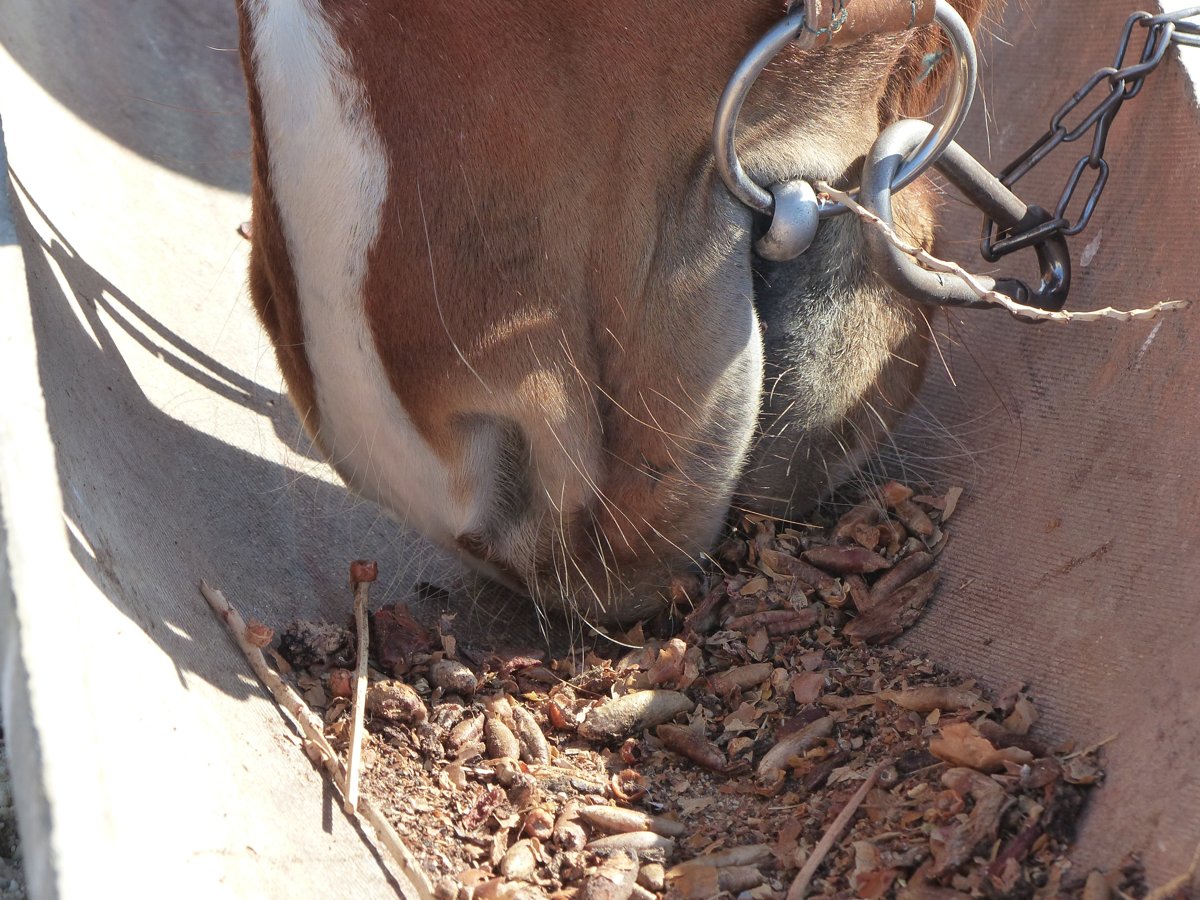
Those long hairs around your horse's muzzle are not stray hairs. They are vibrissae, touch sensors wired to nerves, and they cover the one place your horse cannot see: the ground right under its nose. A horse reads the world through them the way you read it through your fingertips.
Your horse cannot see its own nose
A horse's eyes sit on the sides of its head. That placement gives a wide view of the field and a blind spot directly in front of the face and below the muzzle. The whiskers fill that gap. They pick up touch, vibration, and shifts in air current, and they tell the horse where its lips are relative to food, fences, and fingers. Their vision already works differently from yours, and the whiskers cover the part the eyes miss.
A horse grazing in dim light uses its whiskers to sort safe grass from thorns. A horse reaching for a treat in your palm uses them to find it without biting your hand. A horse feeling its way into a dark trailer uses them to judge the step. The whiskers turn the last few inches in front of the nose from guesswork into touch.
Each whisker is wired to the brain
A whisker is not a thick hair. It grows from a deep follicle packed with nerve endings, and each one maps to a patch of the brain's touch center. A light brush bends the hair and fires the nerve. The horse feels the bend, not the hair itself, which is why the whiskers work in the dark and why a horse flinches when one gets tugged.
Foals are born with long whiskers and use them to find the mare's teat in the first hours of life. Around the eyes, whiskers trigger a blink when something brushes them, which guards the eye before the horse sees the threat. The system is old and simple: touch first, sight second.
Clipping them takes away a sense
Trimming started in the show ring, where a bare muzzle looked tidy. The cost is real. A horse without whiskers bumps into things it cannot see, misjudges distance in tight spaces, and picks up more small facial injuries. A horse that eats dirt or mouths strange objects loses the tool that tells it what it is about to swallow.
The rules have followed the science. The FEI banned trimming sensory hairs on competition horses in July 2021. Germany and Switzerland banned it years earlier under animal welfare law, France followed in 2019, and the British Horseracing Authority banned it in racing from July 2024. Trimming for a vet procedure is still allowed everywhere. In the United States and Canada, trimming is still legal, so the choice sits with the owner.
Leave them alone. If your horse's whiskers look wild, that is the point. They are doing a job no brush can do.