
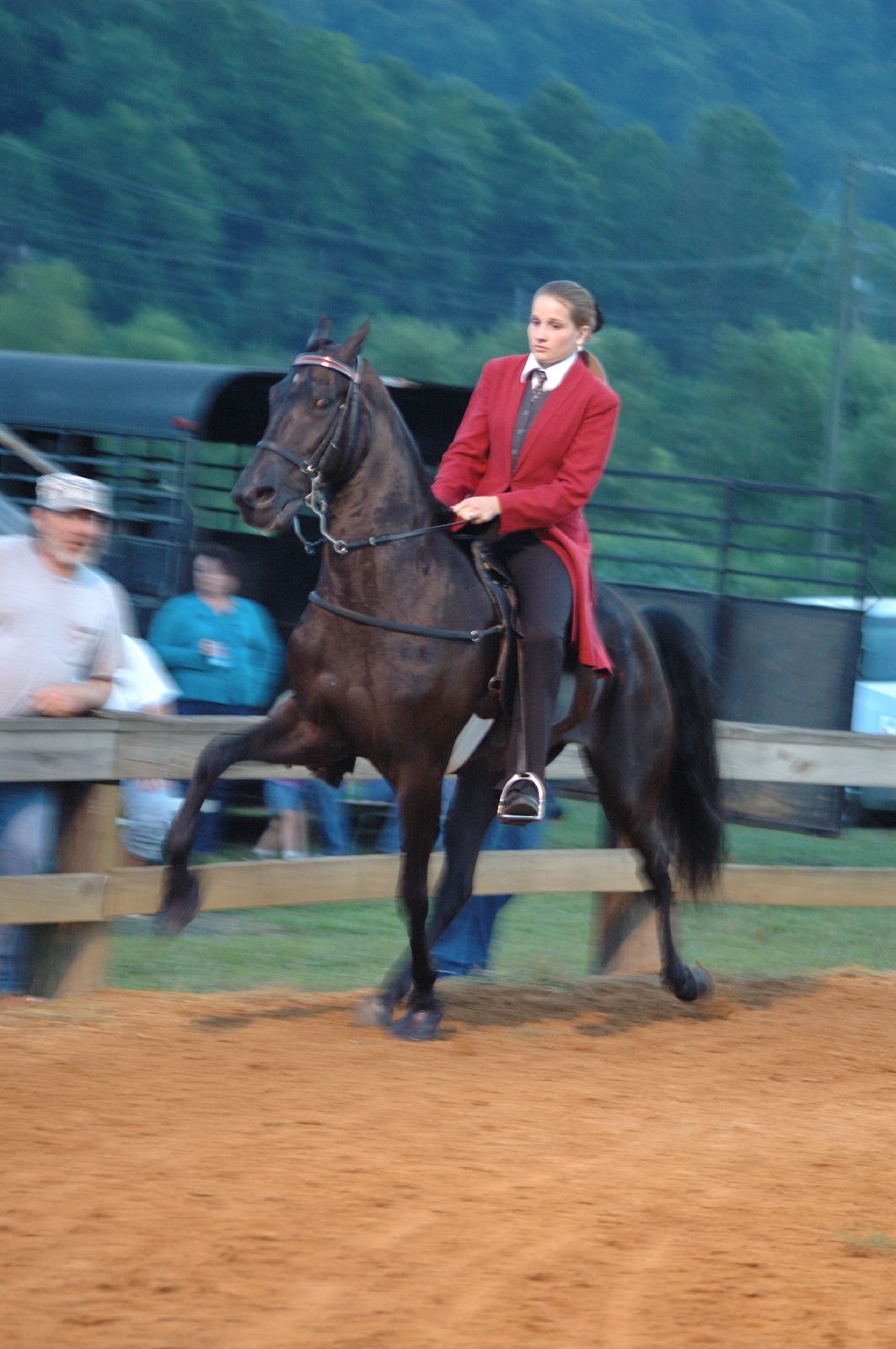
A Tennessee Walking Horse can cover ground at ten miles an hour without bouncing its rider out of the saddle. That smooth ride comes down to a single swapped letter in one gene, DMRT3, that changed how the horse's spinal cord wires itself before birth.
One typo rewired the spinal cord
DMRT3 is active in a set of spinal cord neurons that coordinate the legs. In gaited horses, one nucleotide is swapped, adenine in place of cytosine. That single change inserts a premature stop codon, and the resulting protein comes out 174 amino acids short of full length.
The shortened protein changes how inhibitory interneurons develop in the spinal cord. Those neurons are part of the circuit that decides which legs fire together. With that circuit altered, the strict diagonal pairing of the trot loosens. The horse can move same-side legs together, which is the mechanical basis of pacing and ambling gaits. One copy of the mutation is enough to produce gaitedness. Two copies make it stronger.
Every gaited breed got it from one ancestor
Researchers tested 4,396 horses from 141 breeds and found the same mutation in gaited breeds across Eurasia, Iceland, and the Americas. It arose once, as a single spontaneous mutation, and spread because people bred the horses that rode smoothly. DNA from old bones traced it to medieval England, and the Vikings likely carried it to Iceland in the 10th century.
Breeds known for galloping, like the Thoroughbred, do not carry the mutated form. Neither does the wild Przewalski's horse. Gaitedness is a domestic invention, selected for comfort over centuries.
Harness racers want it, dressage riders don't
The mutation does two things at once. It permits lateral gaits: pace, rack, running walk, tolt. It also inhibits the transition from trot or pace to gallop, so a horse can trot or pace at much higher speeds without breaking stride. That is why the mutation is widespread in Standardbred pacers, where holding the pace at speed is money.
In dressage and jumping, the same trait is a liability. A horse that paces instead of trotting clean diagonals will not score. UC Davis offers a SynchroGait DNA test for the variant, and breeders in non-gaited disciplines use it to select the pacing tendency out.
Shopping for one? Test the gene, then ride the horse
A DNA test tells you the potential. The saddle tells you the rest. Some gaited breeds perform their extra gaits naturally from birth, while others need training to bring them out. Genetics sets the wiring, training shapes what comes through it.
When you try one, ride the breed's signature gait and ask for more speed. A horse that stays smooth is showing you both sides of the equation. And before you buy, run the same pre-purchase exam you would run on any horse. The gene is interesting. The vetting is what protects your wallet.
Riders spent centuries inventing ways to survive the trot's bounce, including posting the trot. Gaited breeds solved the same problem one letter earlier, in the DNA.