
Every horse owner knows the scene. The show starts in an hour, the trailer is open, and the horse has planted all four feet at the bottom of the ramp. Pulling harder makes it worse. The horse that gets dragged in today is the horse that refuses harder tomorrow. Loading is not a strength contest. It is a training problem with a patient fix.
Teach forward before you teach trailer
Start away from the trailer with a go-forward cue. Halter and lead rope on, tap lightly on the horse's hips with a dressage whip, and stop tapping the instant he steps forward. Repeat until he walks a full circle around you on that cue alone.
The cue has to be solid before the trailer enters the picture. A horse that does not understand "forward" in an open field cannot understand it at a ramp, where everything is scarier and narrower. Groundwork first: leading forward, stopping, yielding the hindquarters. If the horse will not do those calmly on the ground, he will not do them at the trailer.
Most loading fights are not trailer problems. They are forward problems. A horse that walks forward on cue has an answer to the ramp question. A horse that only knows how to brace has one move, and it is backwards.
Make the trailer the easy place
Walk the horse to the trailer and let him stand near the entrance with no pressure. If he refuses, move him away and make him work: circles, turns, yielding. Then bring him back and let him rest near the trailer. The contrast teaches the lesson: outside is work, inside is rest.
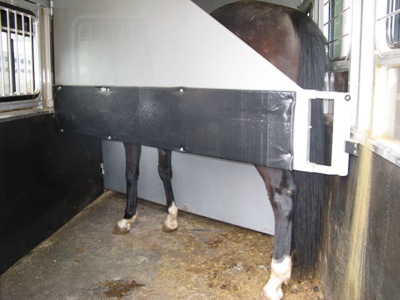
Work in stages and reward the smallest try. Let him stop, stand, and be petted wherever he is comfortable, keeping his nose pointed at the stall. Then ask for one foot at a time on and off the ramp, dozens of reps per foot if needed. That repetition also teaches him to back off calmly, which is the other half of a safe load.
A horse loads willingly when the trailer is the comfortable place. Let him stand inside a few seconds, praise him, and lead him back out. Repeat several times in a row. Practice two to three times a day the first week, then daily for a few weeks, until loading is a habit rather than a negotiation.
Never turn it into a fight
Forcing a horse in trains the next refusal. The struggle becomes one more bad experience attached to the trailer, and the horse will resist again next time, with more conviction. A horse loaded by force and never hurt, with a good ride and good food after, can come around, but that is luck, not training.
When you genuinely must load now, for a vet emergency, build a chute. Use a solid fence or wall on one side and portable panels on the other, secured so a foot cannot go through, so the only route from the pen is directly into the trailer. Food waits inside. The horse still decides to walk in, but there is nowhere else to go.
Patience costs days. A fight costs months, and sometimes costs a person or a horse an injury. A few days of calm sessions beat one bad afternoon at the ramp every time.