
Yes, horses sleep standing up, but the deep kind has to wait for the ground. Their legs lock in place through a system of tendons and ligaments called the stay apparatus, so a horse can doze on its feet without spending muscle to hold itself up. Deep REM sleep only happens lying down.
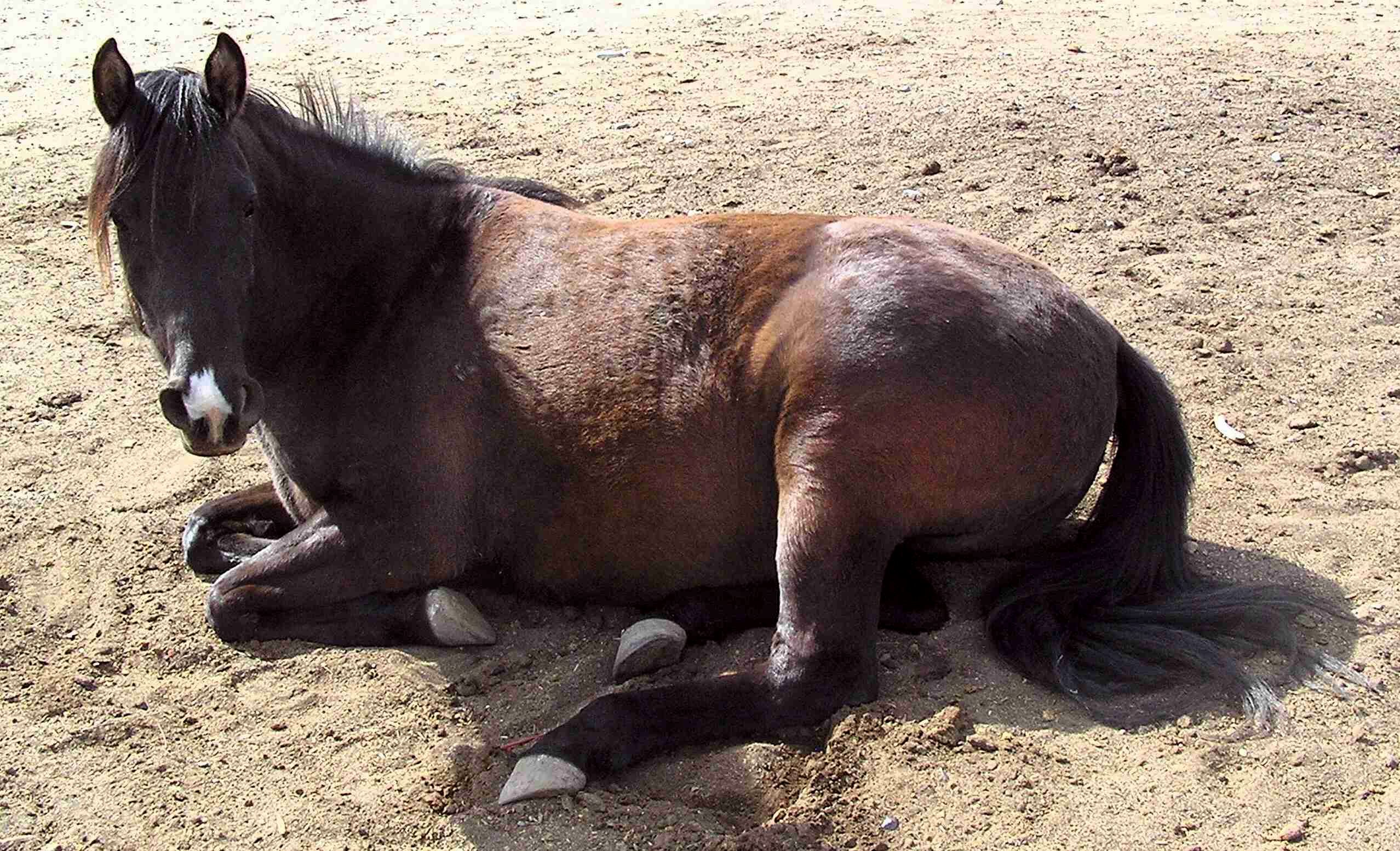
The legs lock, so a dozing horse is barely working
Walk a barn aisle at midday and you will spot it. A horse stands with its head low, its lower lip loose, one hind foot cocked with only the toe touching the ground.
The lock does the work. In the hind leg, the kneecap catches over a ridge on the thigh bone and holds the leg straight. In the front legs, a sling of muscle and tendon carries the weight the same way.
Every so often the horse shifts its weight and swaps the resting leg. The whole arrangement exists for one reason: a prey animal that can bolt the instant something startles it. That same wiring is why horses spook at things that aren't there. The body is built to move first and ask questions later.
Deep sleep only happens on the ground, because REM switches the muscles off
Deep sleep means REM sleep, and REM comes with a loss of muscle tone. A standing horse entering REM would fold and fall, so horses only reach it lying down, flat on their side or resting on their chest with legs tucked.
The numbers are small. A review of equine sleep research put average total sleep at about 3.8 hours a day, with roughly 40 minutes of that in REM, split into about ten sequences of under four minutes each. Researchers at Colorado State University put the short end at under about 25 minutes of REM a day. Foals lie down longer and sleep more than adults.
You can see the split in any pasture. The horse dozing in the sun on three legs is resting. The horse stretched flat out, legs straight, head on the ground, is in the deep sleep it cannot get any other way.
A horse that never lies down is telling you about its stall
Sleep deprivation in horses looks like a training problem first. The horse stumbles, its knees buckle, it seems dull or irritable, and it may collapse without warning. Researchers note these horses are sometimes misdiagnosed with narcolepsy. The signs overlap with pain, so it helps to know how to tell if your horse is sore before deciding what you are looking at.
The cause is usually simpler than a diagnosis. Horses take turns lying down, with one standing guard while others rest. A horse kept alone, or stalled where it cannot see or hear other horses, may stay on guard around the clock, and noise, a cramped stall, thin bedding, or a hard floor push the same way. One study found bedding type changed how long horses spent lying flat, with straw giving longer flat-out rest than shavings.
Before you school that horse harder, fix the stall. Give it room to stretch out fully, bedding deep enough to lie on, and company it can see and hear. Then watch at night, when most lying-down sleep happens. A horse that never lies down for days is a horse to investigate, not a horse to work harder.