
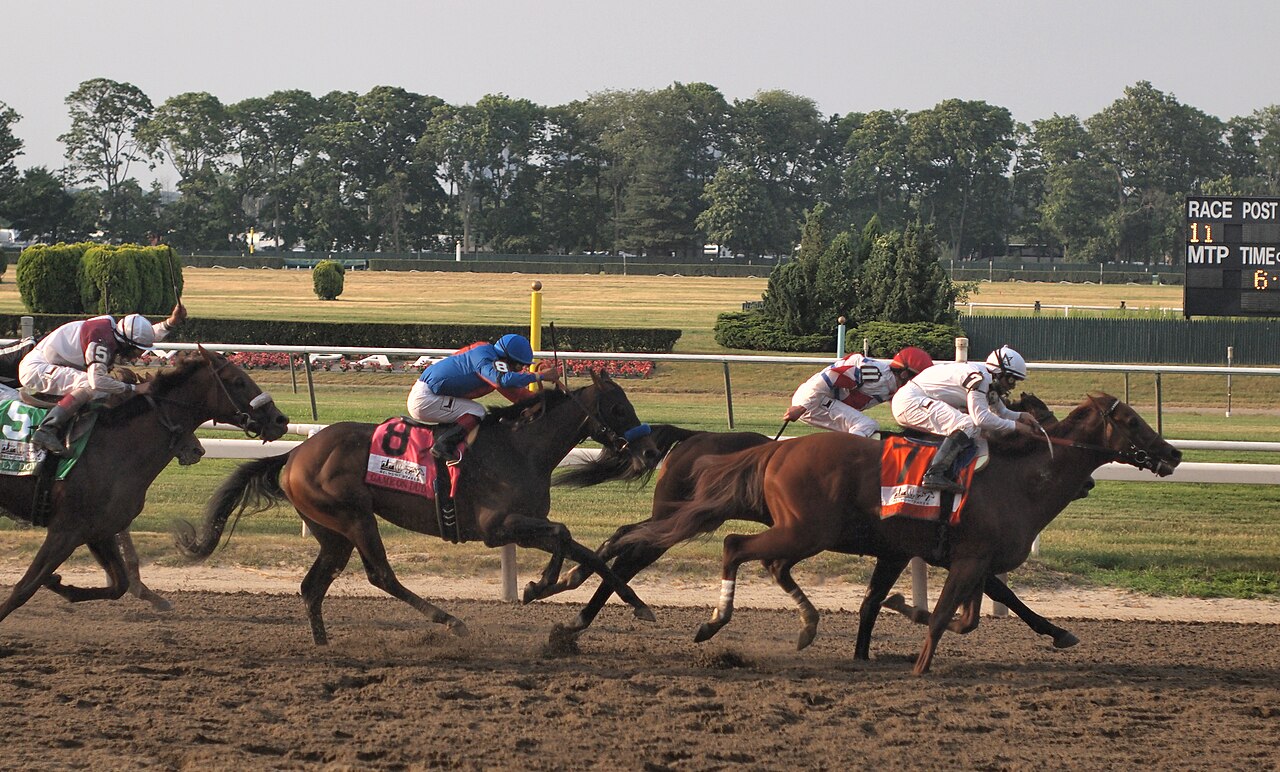
Friday night at Remington Park, a 3-year-old named Royalamerican sat dead last in a field of nine while the 2-5 favorite set a fast pace up front. Then he blew past them all in the stretch and won the $50,000 Silver Goblin Handicap at 34-1, paying $71.20.
Three bad races in a row had buried him in the betting. A sixth at Oaklawn in April, then two fifths at Remington in August and September. Owner-trainer-breeder C. R. Trout gave the reason after the race: "He had EPM real bad." Assistant trainer Kassie Gladd stayed with the horse through the illness and brought him back. He gained 100 pounds to get back to where he was.
EPM eats the wiring a racehorse runs on
Equine protozoal myeloencephalitis is a parasite that attacks the brain and spinal cord. Horses pick it up from feed or water fouled with opossum feces. The parasite is Sarcocystis neurona. It can hit any part of the central nervous system, so the signs vary: a stumbling hind end, a dragged toe, muscle wasting along the topline, a head tilt, trouble swallowing. The MSD Veterinary Manual calls spinal cord signs the most common, with weakness and ataxia in any number of limbs, sometimes with visible muscle atrophy.
Royalamerican's version cost him 100 pounds and three races. That is what the disease does: it takes the muscle and the coordination a horse needs to run, a little at a time. The horse that won two stakes as a 2-year-old looked ordinary by September because the illness had stripped the engine, not the will.
Most horses improve. Few come all the way back.
The approved treatments are ponazuril paste for 28 days, diclazuril pellets for 28 days, or a sulfadiazine and pyrimethamine liquid for 90 days or more. About 60 to 70 percent of treated horses improve, according to the University of Minnesota Extension. Fewer than 25 percent recover completely, per the MSD Veterinary Manual. Relapses can show up as long as two years after treatment ends.
Royalamerican came back all the way, from a bad case, to a stakes win. The treatment killed the parasite. The weight gain, the retraining, the slow return to full work: that was the barn. One person stayed with one horse until the horse was a racehorse again.
A form slump is a vet question first
A horse that runs three bad races in a row usually gets a new rider, a new distance, or a new barn. Royalamerican got a diagnosis and time. The form lines were the disease showing up as slow finishes.
A horse that loses its topline, starts tripping, or fades for no clear reason is telling you about its nerves, not its attitude. EPM mimics lameness, bad behavior, and lost fitness. The same rule holds for soreness: look at the body, not the record. Neurologic disease has shut down barns before, as one EHM case in Los Angeles County showed last month.
Cabrera sat last, watched the favorite burn through fractions of :22.08 and :44.74, and moved when the pace collapsed. "I knew I had plenty of horse under me when we made our move," he said. He had dreamed the night before that he pulled the trigger too late. He did not.
If your horse's form falls off a cliff, ask the vet to check for neurologic disease before you blame the horse. The horse that looks finished might be sick, and the sick horse might still have a stakes win in it.