
A seller tells you a horse is eight. Papers are missing, the horse is unregistered, and the price fits an eight-year-old. Lift the lip before you believe the ad. Teeth do not prove age to the year, but they catch a lie of five years without effort.
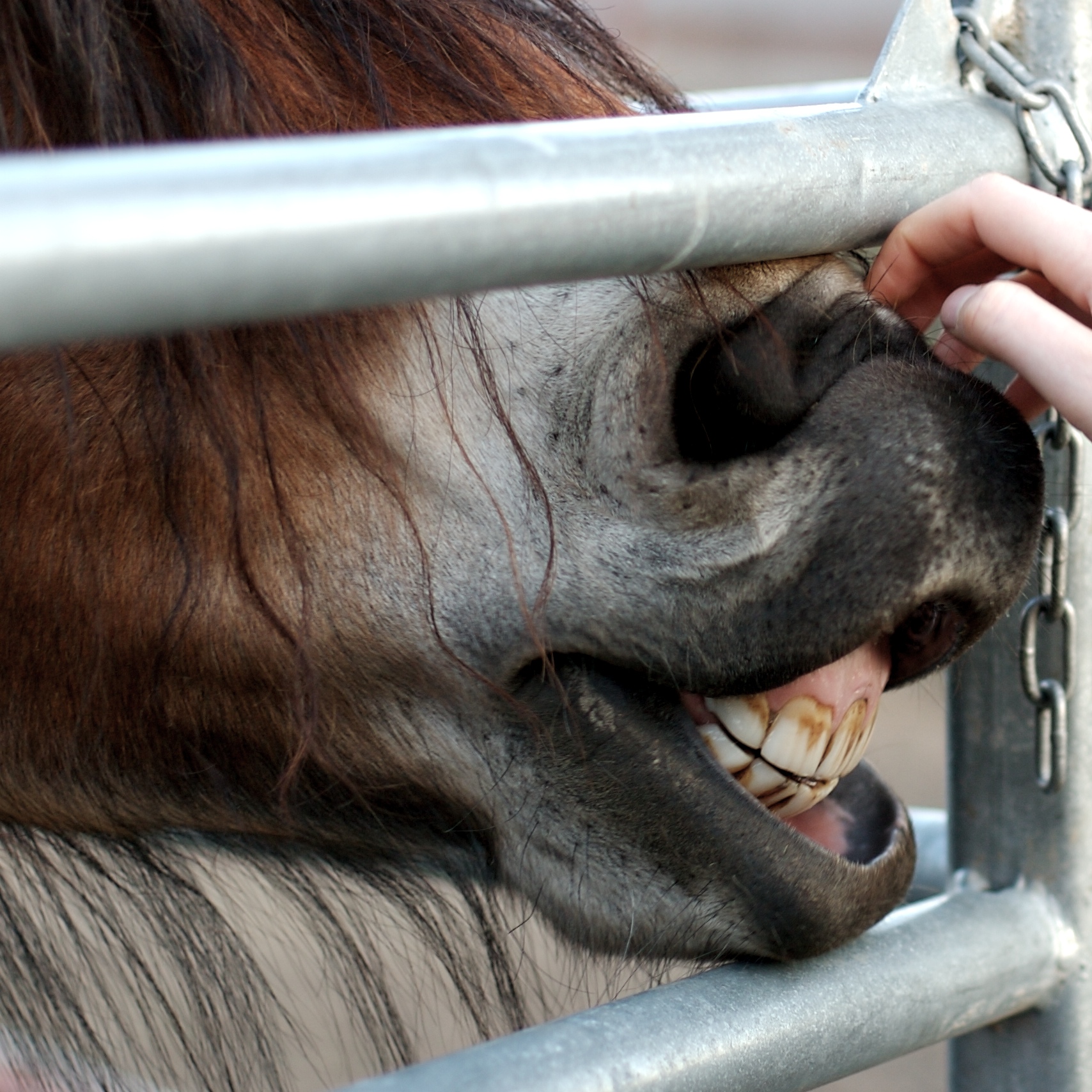
Young horses trade teeth on a calendar
Foal teeth follow a simple count: centrals by 8 days, intermediates by 8 weeks, corners by about 8 months. Milk teeth give themselves away because they are wider than they are tall, with shallow roots.
Permanent teeth replace them from the center outward. Centrals erupt at 2 and a half years, intermediates at 3 and a half, corners at 4 and a half. At 5, every permanent incisor is in and grinding against its partner. Utah State University Extension calls that a full mouth. A corner milk tooth still in place rules out a broke five-year-old.
The cups wear away in a fixed order
Each incisor carries a cup, a dark indented hollow in the grinding surface. Cups disappear from the lower teeth first: centrals at 6, intermediates at 7, corners at 8. Upper cups follow at 9, 10, and 11. Once every cup is gone, at 12 or older, the horse is smooth mouthed.
A second mark takes over where cups leave off. The dental star, a yellowish spot toward the front of the tooth, appears in the centrals at 8, intermediates at 9, and corners at 10. It starts rectangular, then rounds out and drifts to the center of the tooth as the horse ages. Cups in the lower corners plus no dental star points under 8. No cups anywhere plus stars in every tooth points past 12.
Shape and angle give away an older horse
The grinding surface itself changes shape with age. Under 9 it is rectangular. From 9 into the mid-teens it rounds out. In the later teens and beyond it turns triangular.
Older teeth also show more of themselves below the gum line. Horsemen call that long in the tooth, and it is literal: the tooth keeps erupting as the grinding end wears down, so more tooth shows over time. Viewed from the side with the lip lifted, young incisors stand almost vertical. Old incisors slant forward at a clear angle, jutting out from the jaw. No single sign dates a horse alone. The pattern across all of them does.
Galvayne's groove clocks the teens and twenties
The corner incisor on the upper jaw carries the best late-life clue. Galvayne's groove is a dark line that starts at the gum line of that tooth at 10. It reaches halfway down the tooth at 15 and runs the full length at 20. At 25 the upper half has worn away, leaving a groove only on the bottom half. At 30 it is gone.
A hook on the same tooth adds a check. It appears on the upper corner incisor at 7, disappears at 9, and returns at 11, where it can stay into the mid-teens.
Teeth lie when the horse cribs
No method here is exact, and one habit breaks it outright. A horse that cribs wears down the upper incisors against fences and stall doors, flattening the very surfaces these marks are read from. Diet changes wear too: a horse grinding sandy hay wears faster than a horse on soft pasture.
Use teeth as a screen, not a verdict. If the mouth and the story disagree by years, ask for papers, vet records, or a dental exam.